
The following narrative is offered by Lucas at GoWesty! Camper Products in an effort to finally put to rest the controversy with regard to tire and wheel choices for the VW camper. It is a bit sarcastic in some places, so it is not advised for the squeamish. Our sarcasm is a result of our exasperation over the continued debate about an issue which, we feel, we have adequately resolved years ago. There is no insult intended here. Just trying to clarify the situation and put a little humor into it at the same time. Enjoy!
Sincerely, S. Lucas Valdes, PEME
President of GoWesty Camper Products
A division of PE Enterprises, Inc.
About wheels:
This (photo to the right) is an example of the 16" diameter by 7.5" width wheel / Michelin 215/60-16 Hydro Edge tire and wheel set we sell here at GoWesty for the VW Vanagon. It was returned to us by one of our customers who, while driving off-road in her fully loaded Syncro Westfalia camper, hit what she described as a "VERY BIG HOLE" at about 45 mph. Notice the wheel has taken on a rather square shape, and all of the air has rushed out of the tire. The wheel did not come loose. It did not crack or crumble in any way. It just smooshed.
My personal experience: I had a set of these exact wheels and tires on my personal pop-top Vanagon for 9 years, during which time I drove 90,000+ miles over all sorts of terrain and weather conditions. The damage done to this wheel is not unlike the damage that occurred to one of my wheels when my sweet wife (love you, honey) became distracted momentarily, drove off the road and hit the edge of a 12" concrete drainage ditch. It pretzeled the wheel about 30% MORE than the one in the photo. In fact, it bent the wheel so much that the inside of the wheel caught the front brake caliper, suddenly stopping the wheel from rotating, causing the van to come to a screeching halt. Again, the wheel did not come loose, nor did it crack or fail in any other way. It simply deformed in the same way a typical, factory original steel wheel (or just about any other non-brittle wheel) would under the same conditions. I took the tire off the rim, sent it out to have it straightened, mounted THE SAME TIRE back on, installed it back on my van and drove on it for another year. In fact, the only reason I eventually replaced the tires was so we could start testing Michelin's latest tire, the HydroEdge, which are still on that vehicle to this day.
Now, there has been much hoopla with regard to the load rating of various wheels and tires used on Vanagons. Some have criticized us for selling these wheels for use on VW campers in the 15" and 16" diameters without knowing exactly what the factory load rating is. So, OK, we don't know what the manufacturer's load rating is. We tried to obtain this information, but were not successful. We have been criticized because we have stated on several occasions, "Believe me, they are strong enough." How do we know they are strong enough? Well, after all, these wheels were originally designed to fit many different Mercedes models, including their full-sized 126-body car available in very high performance models. Mind you, these are cars that can weigh MORE than a typical Vanagon, are capable of TWICE speed, cornering capability and braking, and have over 4 TIMES the horsepower of a Vanagon. What other evidence do we have to support the claim of "strong enough"? Ummmm... look at the photo!
Okay, for some people logic and seeing is not believing. It seems that we should have some sort of professional engineer to take a look at the situation and see what he thinks. "Maybe get a professional opinion," you say. Well, perhaps I can be of some assistance. I have a degree in Mechanical Engineering from Cal Poly State University in San Luis Obispo. I also took and passed (on the first try) ALL 16 HOURS of the state of California's exams and received my Professional Engineering license in Mechanical Engineering. Only about one in three individuals pass these tests on the first try. A professional engineering license is the engineering equivalent to a medical doctor's "MD." It is kind of what the BAR exam is to lawyers. Passing the exams doesn't mean you are a genius, nor does it mean you are just "book smart" enough to get a degree; it means you can actually apply the knowledge to solving problems, on the spot, within a time limit. So, OK, some people say, "Big deal, experience is what matters." Well, my first job out of college was as a mechanical engineer for FMC Corporation in Santa Clara, California. I spent five years as a—you guessed it—failure analysis engineer. My job was to set up tests that would take various components of off-road military vehicles to the limit. Now, I spent many hours first calculating the theoretical limits of these components, of course. But you better believe that was NEVER enough. Calculus or not, my client wanted to see broken parts. Period. So, no matter what the numbers said, we would strap that shock, or that suspension control arm, or that road wheel, or whatever it was to a big effing machine and work it 'til it broke! There is no substitute for TESTING. While others in the industry have been pontificating on what wheel and tire to use on the VW Bus, Vanagon, and Eurovan, we at GoWesty Camper Products have been TESTING on our own vehicles for the past 20 years and hundreds of thousands of miles. As far as we—and any logical thinking person with better things to do—are concerned: The issue of wheel strength is a NON-ISSUE.
About tires:
So, just as when I bought my first 'keeper" camper in 1985 (a 1979 VW Bus camper, which I still own), when I bought my first Vanagon pop-top in 1994 the first things to go were the wheels and tires. The use of 14" wheels and tires on the late VW Bus and Vanagon is just plain stupid... I think everyone agrees on that. The first thing I noticed back in 1985 was that there was absolutely no 15" wheel option for my Bus. So, I made some. I took a set of original 14" VW Bus wheels, cut the welds and knocked out the centers, bought some 15x7" Pontiac "drop-center" rally wheels did the same. I threw away the VW outers, threw away the Pontiac centers, and welded the VW centers in the Pontiac outers (in my backyard, actually), thus creating a 15x7" wheel for my VW camper. When I started shopping for a tire I found that the perfect tire in terms of size was the 215/65-15, which is still the tire size we use today. That tire size was less than 1/4" difference in radius than my original, spindly 185SR14 tires, and there were 20+ different brands and models from which to choose. BUT WAIT! OH NO! What about load rating? The 14" tires were "specially formulated" for the VW vans, right? These 14" tires are super cool and reinforced to handle the mass of the vehicle, right? I was told flat out by tire stores that, "No way, you can't put a non-reinforced tire on that vehicle! It will just blow up!" What to do, what to do...
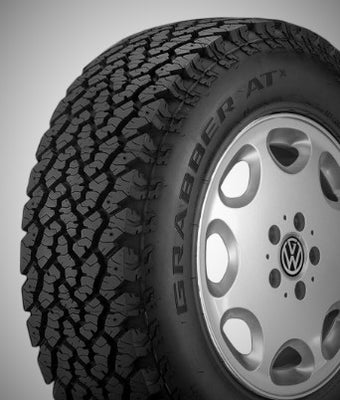
Wait a minute! Again, more hoopla! Where is the common sense? Any run-of-the-mill 215/65-15 passenger-car tire is rated for around 1500lbs. The tire we currently use is the Michelin HydroEdge™ with an 800 tread wear rating (read: 80,000-mile typical life expectancy), and is rated at 1510 lbs. each. That is one thousand, five hundred and ten pounds of continuous loading, all day, all night, until they are worn out. And there are four of them, right? That adds up to, like, what... 6040 pounds of continuous combined load carrying capability? What does a VW Bus, or for that matter, a FULLY LOADED VW pop-top Vanagon weigh? Anyway, you get my point; you don't have to be an engineer to figure this one out. The thing is this: comparing a 185SR14 tire on a 14x5.5" wheel to a 215/65-15 tire on a 15x7" wheel is like comparing apples and oranges. On the latter, the sidewalls are almost 1/2" shorter, and are 1-1/2" further apart. Common sense would indicate what we have proven by TESTING: The wider and lower profile tire is INHERENTLY stronger and more stable than a narrower and taller tire. No reinforcement required. End of story!
So some might say, "But are you unbiased, Lucas?" Well, you got me there. HELL NO, I AM NOT UNBIASED. Of course I want to sell our wheel and tire packages. But at GoWesty, we're not in business for a quick buck. We install and use EVERYTHING we sell right here in our own state-of-the-art, immaculate shop, on our customers and on our own (not always so immaculate) VW campers. We use this stuff. We breathe this stuff. Besides, where else are you going to find a 15" alloy wheel and tire package that is guaranteed to fit, last, look great, includes all the fasteners needed, custom center caps, mounted, balanced, and installed (if you come to our shop) for the price of a GoWesty set? Nowhere, that's where.
And finally, lets talk about value: When the last Michelin 205/70-14 reinforced tires were available (and they have not been for over 5 years now), some folks were paying almost $600 per set installed. Compared to the Michelin 215/65-15 HydroEdge™ tire we currently use, they would only last about 60% as long. So if you do the math, switching to our better handling, nicer looking, and longer lasting 15" option actually saves you money over time. There is just no down side.
So, that is that, thank you.
GoWesty! Camper Products is a privately owned company specializing in parts, accessories, sales and service of Volkswagen (R) campers. It is not affiliated in any way with Volkswagen of America or Volkswagen AG. "Vanagon", "Bus", "VW", "Volkswagen", and "Eurovan" are registered trademarks and should be considered as such throughout our entire website.